


 Pristupačnost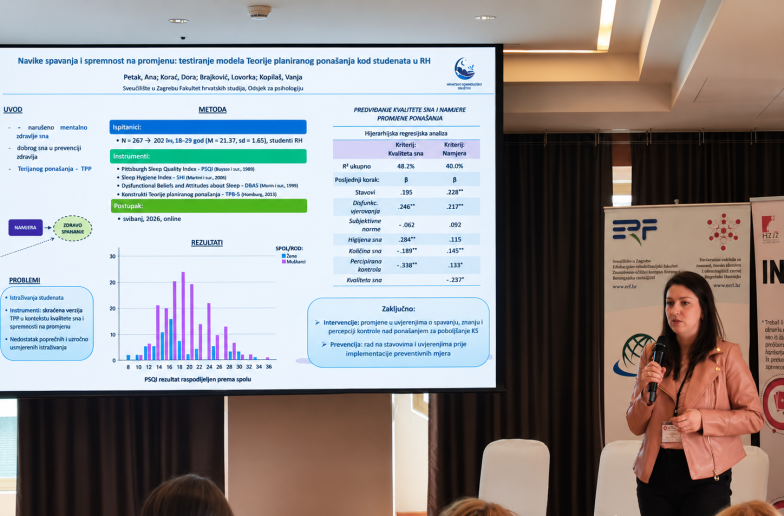
The first regional conference, PREVREG – Building the Foundations of Prevention Science in the Region, was held in Zagreb on 10 and 11 June 2026. The conference was jointly organised by the University of Zagreb Faculty of Education and Rehabilitation Sciences, the Croatian Institute of Public Health, and the Centre for Addiction Prevention in Sarajevo, under the auspices of the European Union Drugs Agency.
The conference brought together researchers and practitioners with the aim of strengthening and advancing evidence-based prevention of behavioural problems and promoting mental health across the region. The two-day programme presented contemporary standards in prevention science, effective preventive interventions, and examples of regional public health policies focused on improving mental health and preventing risk behaviours.
Assistant Professor Ana Petak from the Department of Psychology at the Faculty of Croatian Studies actively participated in the conference programme by presenting the findings of two original research studies.
The paper entitled Sleep Habits and Readiness for Change: Testing the Theory of Planned Behaviour Model among University Students presented preliminary findings from the institutionally funded Faculty of Croatian Studies project The Preventive Potential of Sleep Quality and Sleep Habits among University Students. The project is led by Assistant Professor Ana Petak, with Associate Professor Lovorka Brajković, Assistant Professor Vanja Kopilaš, and Dora Korać, MSc in Psychology, serving as members of the research team.
More than 50% of students were found to have impaired sleep quality, which represents an important risk factor for a range of health problems. The findings highlight perceived behavioural control as an important factor associated with intentions to adopt healthier sleep habits and provide valuable guidance for the development of preventive interventions.
The second paper, Between Support and Loneliness: How Cognitive Distortions and Social Support Shape Social and Emotional Loneliness, was co-authored with Marina Trbus, MSc in Psychology, from the Kauch Psychological Centre. The study resulted from cooperation with counselling practice and emphasises the importance of applying different preventive approaches tailored to specific dimensions of loneliness.
Further information is available on the official conference website:
https://www.erf.unizg.hr/prevreg