

 Pristupačnost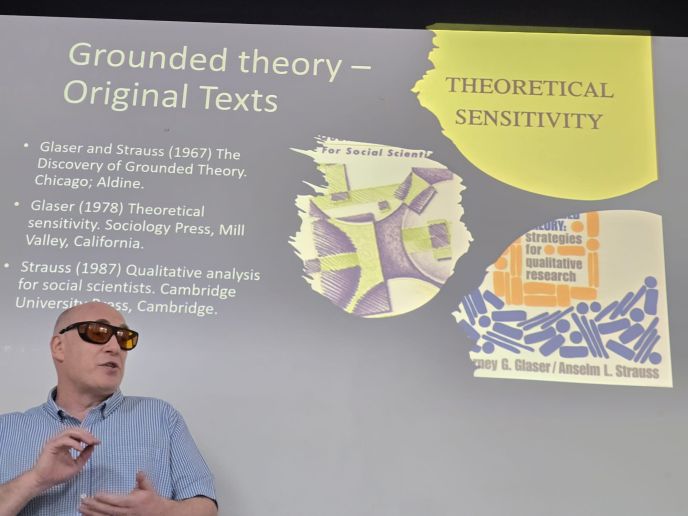
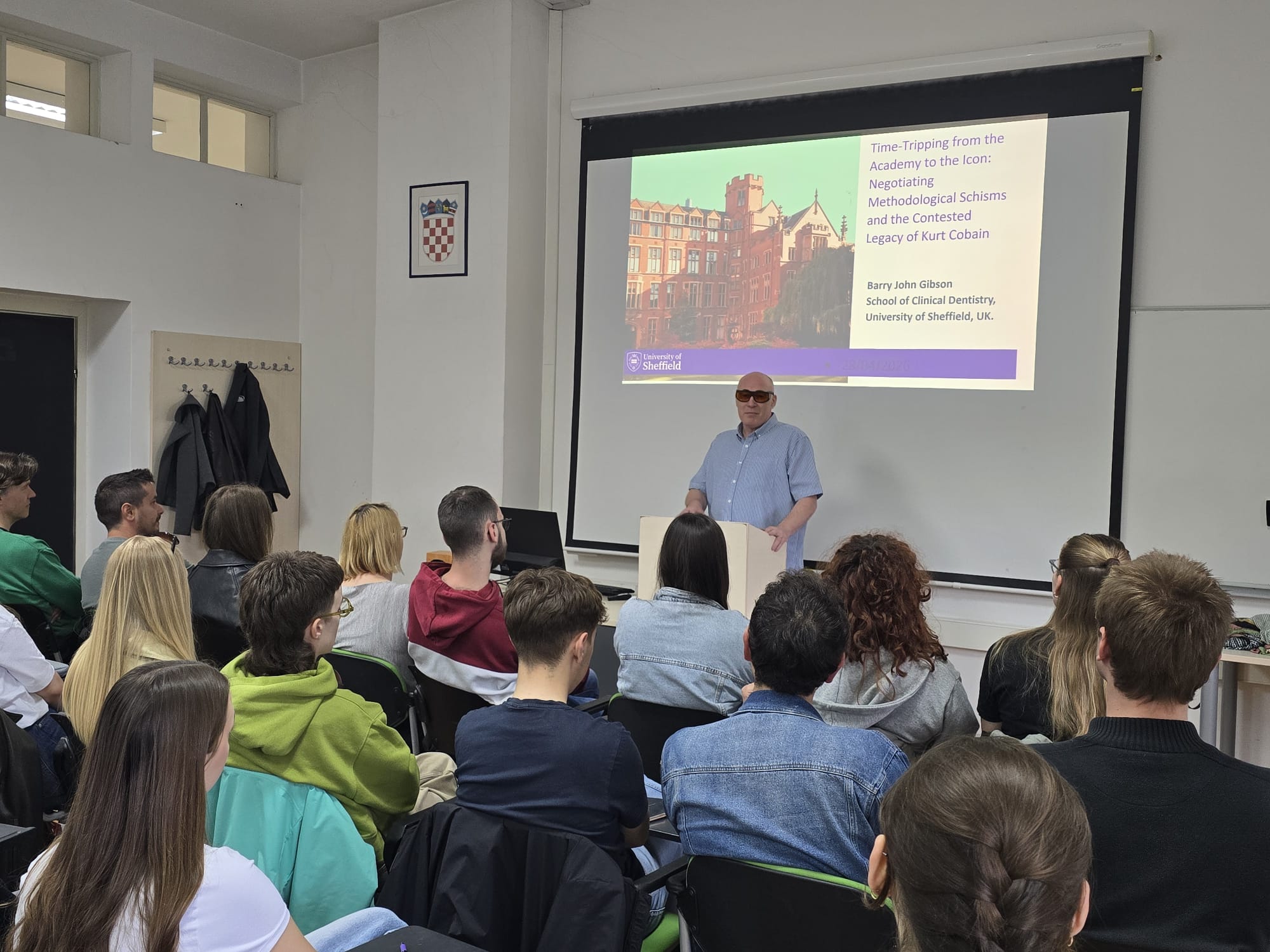
A guest lecture by Professor Barry J. Gibson of the University of Sheffield, entitled “Time-Tripping from the Academy to the Icon: Negotiating Methodological Schisms and the Contested Legacy of Kurt Cobain,” was held today at the Faculty of Croatian Studies as part of the institutional research project DIGI-HR.
The considerable interest in the lecture was evident even before it began: the Šibenik lecture hall was filled to capacity, with additional seating in demand. The lecture was attended by sociology students, faculty members, and members of the DIGI-HR research team.
In his lecture, Professor Gibson addressed the relationship between history and collective memory, demonstrating how social groups continually reinterpret past events from the perspective of present-day social circumstances. Central to his lecture was the concept of time-tripping, through which he explained the ways in which the past is reconstructed and adapted to contemporary social needs, values, and conflicts.
The first part of the lecture was devoted to the development of grounded theory, one of the key qualitative methodologies in the social sciences. Professor Gibson presented its development, internal theoretical debates, and various strands of contemporary methodological advancement, emphasizing that scholarly debates on methodology often reflect broader transformations within the social sciences and humanities.
Particular attention was drawn to the section of the lecture in which, through the example of Kurt Cobain, the frontman of Nirvana, Professor Gibson illustrated how social memory is shaped through diverse personal, media, and cultural narratives. By analysing memoirs and biographical accounts written by individuals who were part of Cobain’s private and professional life, Professor Gibson raised the question of who participates in shaping a person’s historical legacy and how different interpretations contribute to the formation of a socially accepted image of the past.
Professor Gibson emphasized the importance of understanding the ways in which societies shape and sustain historical narratives, particularly in the context of divided and post-conflict communities. Through examples of contemporary social conflicts, he demonstrated how collective memory can play an important role in shaping social identities, political attitudes, and attitudes towards the past.
Students took the opportunity to engage in discussion with the guest lecturer and learn first-hand about the relationship between history and social memory, as well as the role of popular culture in shaping collective narratives.
Professor Gibson’s visit was the second in a series of international lectures organized within the framework of the DIGI-HR project. It should be recalled that on Tuesday, 5 May, the Faculty of Croatian Studies also hosted a guest lecture by Professor Christian Morgner of the University of Portsmouth on generative artificial intelligence as a “laboratory of questions,” thereby continuing DIGI-HR’s efforts to open up space for interdisciplinary discussions on contemporary social and technological change.