

 Pristupačnost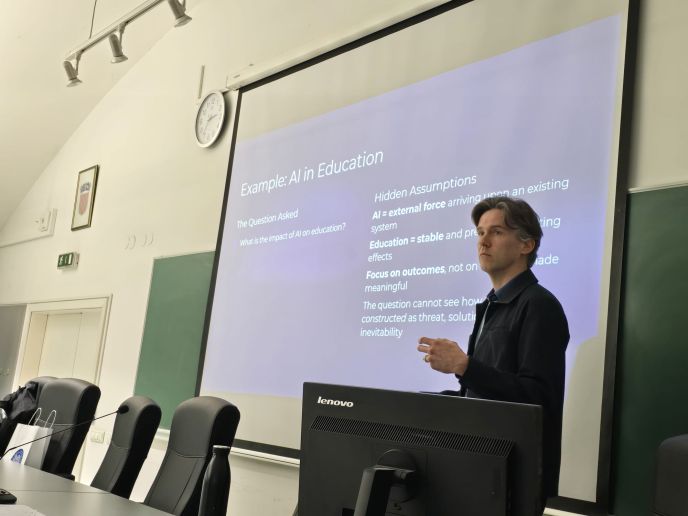
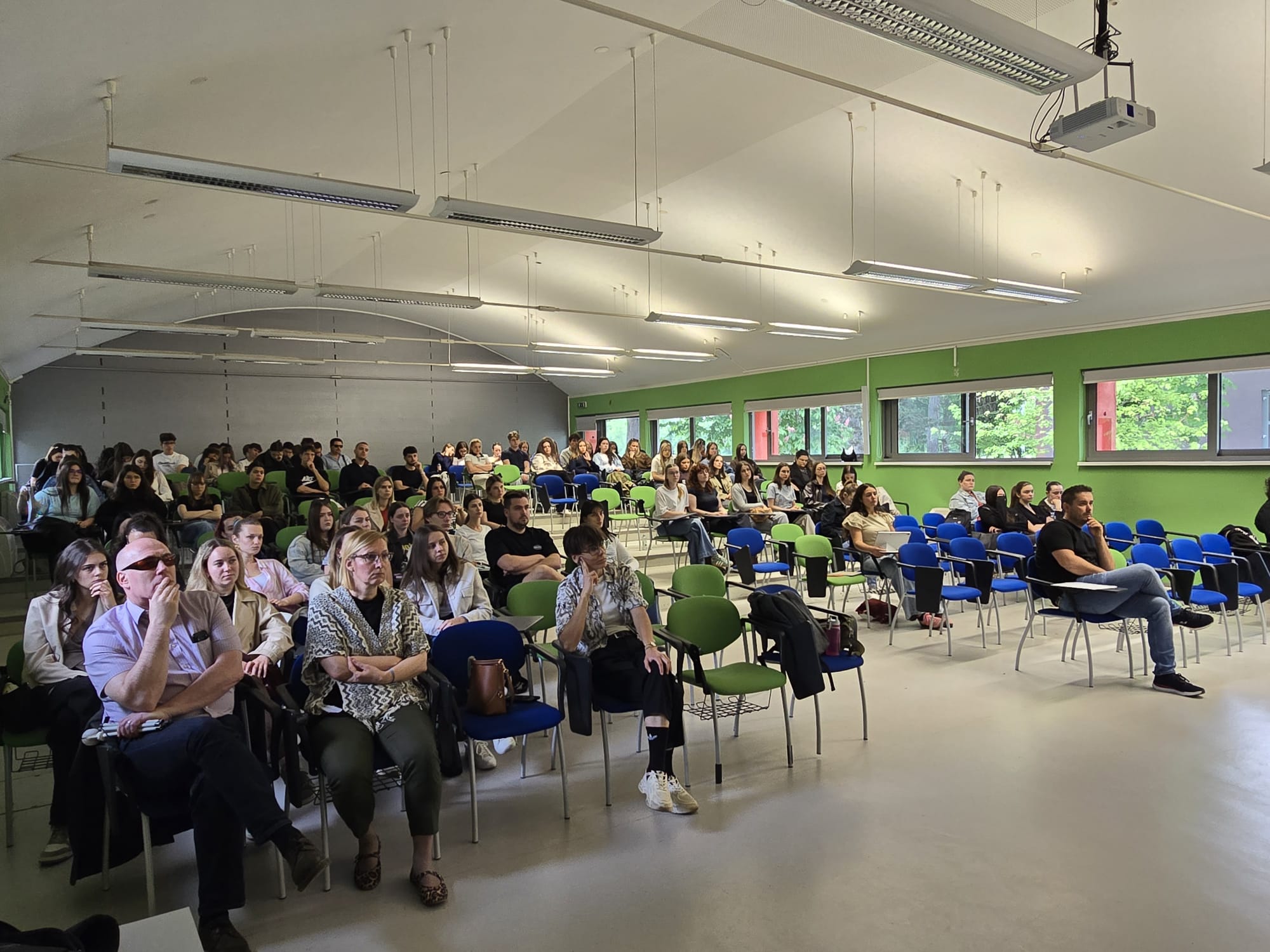
A guest lecture by Professor Christian Morgner of the University of Portsmouth, entitled “Generative AI as a Question Laboratory: From Answers to Questions”, was held yesterday, 5 May, at the Faculty of Croatian Studies, University of Zagreb. The lecture was delivered to sociology students as part of the institutional research project DIGI-HR.
In his lecture, Professor Morgner problematised the dominant understanding of artificial intelligence as a technology that produces answers, proposing a different approach: generative artificial intelligence as a tool for creating, comparing, and reformulating questions. The starting premise of the lecture was that questions are not neutral, but already contain theoretical assumptions about the world, responsibility, and social problems, and that research does not begin with a question, but rather with a situation of indeterminacy that the question subsequently shapes and stabilises.
He particularly emphasised that standard research questions such as “What causes obesity?” or “What is the impact of artificial intelligence on education?” often predetermine the way in which we understand a problem, directing research towards causes while neglecting the conditions that made it possible for a particular phenomenon to be recognised as a social problem in the first place. As an alternative, he proposed the analytical framework of the question “How is something possible?”, which redirects attention towards the social, communicative, and institutional conditions under which particular phenomena emerge.
At the centre of the lecture was the idea of a “sociology of questions” — an approach that examines how certain questions become socially legitimate, research-relevant, and politically significant. Morgner demonstrated that every question simultaneously makes something visible while excluding something else, thereby shaping in advance the boundaries of research, the distribution of responsibility, and the possible forms of social intervention.
Speaking about generative artificial intelligence, Professor Morgner emphasised that its most important sociological potential may lie not in generating answers, but in opening up new perspectives and creating alternative ways of asking questions. Through examples from the fields of health, alcohol consumption, and education, he showed how artificial intelligence can serve as a tool for comparing different theoretical approaches and revealing the hidden assumptions that structure social knowledge.
Christian Morgner stressed that changing the question also changes the way we understand social reality, actors, and possible futures. In this respect, generative artificial intelligence can become an important research tool for developing a more reflexive and critical sociology of contemporary social change.
Professor Morgner’s stay at the Faculty of Croatian Studies forms part of a programme of guest lectures taking place this week within the framework of the DIGI-HR project. The next lecture will be held on Thursday, 7 May, by Professor Barry J. Gibson of the University of Sheffield. In his lecture, entitled “Time-Tripping from the Academy to the Icon: Negotiating Methodological Schisms and the Contested Legacy of Kurt Cobain”, Professor Gibson will address issues of collective memory, social power, and cultural interpretations of the past, linking methodological debates on grounded theory with an analysis of Kurt Cobain’s reputational legacy and the broader social dynamics involved in shaping historical memory.