


 Pristupačnost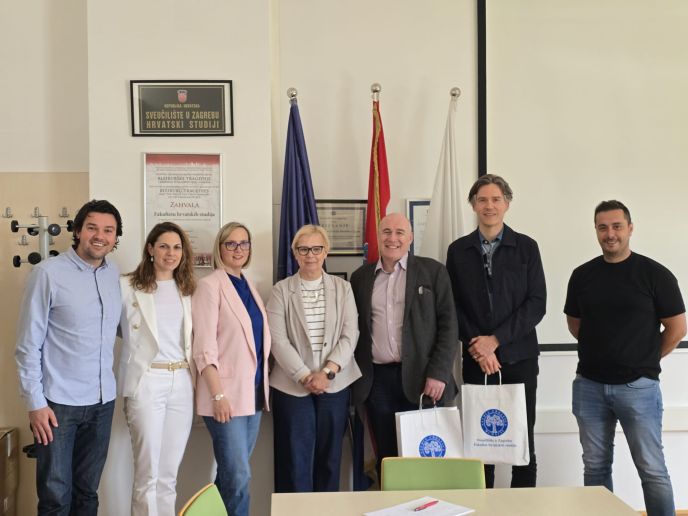
A meeting with visiting professors from the United Kingdom, Professor Barry J. Gibson of the University of Sheffield and Professor Christian Morgner of the University of Portsmouth, was held today at the Faculty of Croatian Studies, University of Zagreb. The professors are currently visiting the Faculty as part of the institutional research project DIGI-HR. The meeting provided an opportunity to present scholarly interests, exchange experiences, and discuss possibilities for future international cooperation, internationalisation, and the development of new teaching and research projects.
In addition to the guests, the meeting was attended by Assistant Professor Vanja Kopilaš, Vice-Dean for Teaching and Students; Assistant Professor Antonija Ordulj, Vice-Dean for International Cooperation; Professor Irena Cajner Mraović, Head of the Department of Sociology; Assistant Professor Erik Brezovec, project leader; and Assistant Professor Ana Marija Dunaj, member of the research team.
Project leader Assistant Professor Brezovec emphasised that the visit of Professors Gibson and Morgner was organised within the framework of the DIGI-HR project, which, in addition to its research dimension, creates opportunities for strengthening international cooperation and exchanging experience, as well as potentially establishing institutional agreements with the universities from which the visiting professors come. He noted that such cooperation could result in the development of new courses taught in English, the involvement of international professors in teaching activities, and the strengthening of the international visibility of the Faculty of Croatian Studies. He added that the visiting professors’ experience in the field of internationalisation is highly valuable for the further development of the Faculty and its study programmes.
During the meeting, Professor Christian Morgner presented his area of scholarly interest, which focuses on digital culture and social innovation, while also highlighting his extensive experience in the internationalisation of higher education. He pointed out that internationalisation cannot be developed hastily, but requires long-term planning, administrative preparation, and a strategic approach. He emphasised that one of the key challenges facing European universities today is attracting students in an increasingly competitive global academic environment. In particular, he noted that when choosing a study programme, students consider not only the quality of the programme and the degree itself, but also the broader living experience, including the safety of the city, accommodation opportunities, social life, and similar factors.
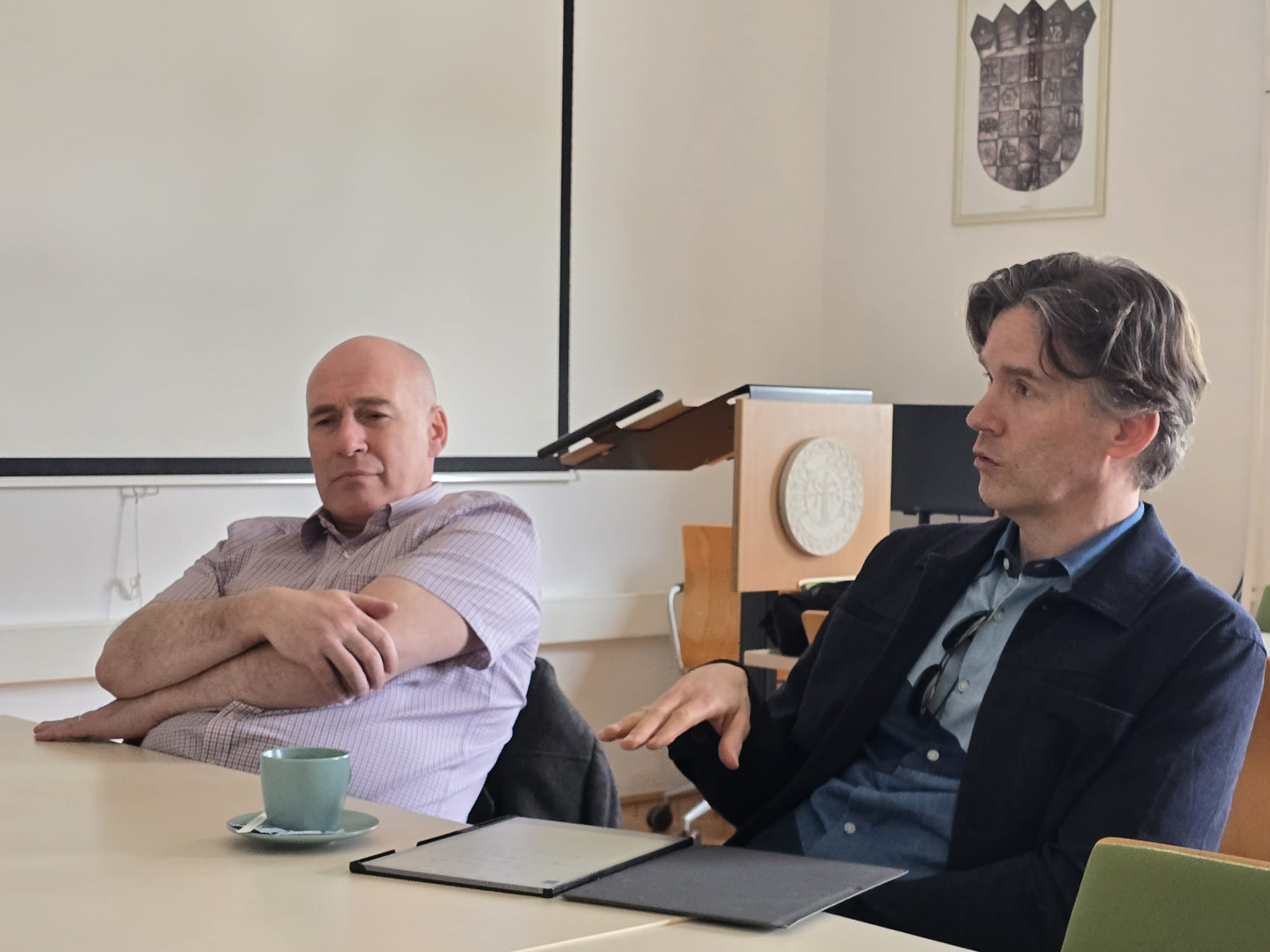
Professor Barry Gibson presented his work in the field of medical sociology and public health, noting that he has been teaching the sociology of health for more than twenty years and has participated in the development of international academic programmes. He drew particular attention to the challenges related to the integration of migrant students into higher education, stressing that migration flows are becoming increasingly important in the context of European universities. In this regard, it was emphasised that Croatia’s demographic challenges further increase the need to attract international students and develop sustainable models of internationalisation.
A significant part of the meeting was devoted to the challenges of contemporary higher education, particularly the position of the social sciences and humanities, which are increasingly faced with reduced staffing capacities and institutional pressures. The discussion highlighted that the decreasing number of academic staff and growing teaching obligations increasingly affect the possibility of developing research activities.
In this context, Professor Irena Cajner Mraović emphasised that the Department of Sociology at the Faculty of Croatian Studies is the smallest sociology department in Croatia in terms of the number of academic staff, but that it nevertheless achieves exceptional results. She noted that the undergraduate study programme in Sociology at the Faculty is one of the most sought-after sociology programmes in Croatia, which confirms the quality of its work. It was emphasised that the value of study programmes cannot be reduced solely to quantitative indicators, and that the quality, commitment, and expertise of academic staff play a crucial role. At the same time, it was noted that any additional support and cooperation would be welcome, particularly in situations where academic staff, due to heavy teaching workloads, sometimes have to temporarily place research work in the background.
The discussion also highlighted that the internationalisation of higher education contributes not only to academic quality and the exchange of knowledge, but also has a broader socio-economic impact. Participants emphasised that international students contribute to the local economy during their stay through spending and active participation in the social life of the community.
The organisation of summer schools was identified as one possible model for developing the Faculty’s international visibility, for example through programmes focused on learning the Croatian language, becoming familiar with local culture and society, and engaging with interdisciplinary academic content. In this context, particular emphasis was placed on the need to make use of Croatia’s comparative advantages, such as its pleasant climate, geographical proximity to the Adriatic coast, and safe living environment, as important elements in attracting international students, especially those from Asian countries.
Vice-Dean Ordulj welcomed the guests and presented the Faculty’s international activities, noting that the Faculty currently has 22 Erasmus agreements, with the highest number of mobilities coming precisely from the field of sociology. She emphasised the Faculty’s openness to new forms of international cooperation and the possible expansion of its partner network.
Vice-Dean Kopilaš thanked the Department of Sociology for its continuous contribution to the development of the Faculty, emphasising that the Faculty of Croatian Studies is a young faculty that systematically develops interdisciplinary approaches in teaching and research. Kopilaš also spoke about the importance of connecting different disciplines in the contemporary academic environment.
At the conclusion of the meeting, it was emphasised that the further development of international cooperation and internationalisation will be an important strategic direction for the Faculty of Croatian Studies in responding to the challenges of contemporary higher education, demographic change, and the global competitiveness of universities.
Following the meeting, Professor Christian Morgner delivered a lecture to sociology students entitled “Generative AI as Question Laboratory: From Answers to Questions”, in which he opened a discussion on the transformative potential of generative artificial intelligence in contemporary society, science, and communication. Professor Barry J. Gibson will deliver his lecture, entitled “Time-Tripping from the Academy to the Icon: Negotiating Methodological Schisms and the Contested Legacy of Kurt Cobain”, on Thursday, 7 May. In his lecture, he will address collective memory, social interpretations of the past, and cultural conflicts surrounding historical memory.