

 Pristupačnost
I remember exactly how I got my acceptance for Zagreb. A fellow student came up to me and said that the cities for our Erasmus semester had been announced. And there it was: University of Zagreb. It was actually my fourth choice, but in retrospect it was exactly the right city for me.
Preparation
Since a semester abroad is mandatory in my International Sociology program, the first step was to decide which city to go to. I originally wanted to go to France, so I took French language courses in Eichstätt during my first three semesters. France was also my first choice among the universities listed. When I received confirmation for Zagreb, I switched from French to English in the fourth semester, which I think was enough to feel a little more confident and prepared in English. I also tried to learn Croatian on language apps to get a feeling for the language. But that didn't work, so I started my semester abroad with no knowledge of Croatian. However, since the University of Zagreb offered a free language course specifically for Erasmus students, that wasn't a problem.
The deadlines for submitting documents for Zagreb were quite short, so the most stressful part of the Erasmus semester began in Eichstätt. The emails sent by the University of Zagreb with instructions for the registration process are all written in a clear and understandable manner. It is important to check your emails regularly, otherwise you may run the risk of missing the short deadlines. In the end, however, everything worked out well on both sides, KU and the University of Zagreb, so that the “bureaucratic” part was taken care of relatively early compared to other Erasmus universities. Once I arrived in Zagreb, almost all of the courses I had previously selected had to be changed, but I received excellent support, so that wasn't a big problem.
Finding accommodation
Another rather complicated part of the preparation process was finding accommodation. Since I was rejected by the student dorms in Zagreb, I had to look for something privately. Fortunately, the university's website also links to other websites where you can search for private accommodation. So at least I had a starting point and wasn't left completely empty-handed. The apartment search took a long time and was not entirely problem-free. However, I can recommend looking either on HomeInZagreb or in Facebook groups. The latter in particular provides lots of tips and ads from both seekers and landlords who are looking for or renting out an apartment or room. I can particularly recommend the Facebook groups if you are going to Zagreb alone and prefer to live in a shared apartment. I finally found my apartment through HomeInZagreb.
In Zagreb, I would also check which part of the university you are at, as it took me about an hour to get from my apartment to my faculty by public transport. At first, everything is still new and the hour passes quickly, but once you've settled in a bit and university starts at 8:00 a.m., the hour there and then another hour back can be a bit tedious.
Costs
I mistakenly went to Zagreb thinking that everything would be cheaper there. In supermarkets such as Lidl, Konzum, and Spar, I would say that food prices were exactly the same as in Germany. Many items at DM were even more expensive, but the selection was exactly the same as in Germany. This means that my living costs did not change. What was very expensive was the rent for the apartment. Since I did not get into the Croatian student dormitory, the monthly rent was €600. In the student dormitories, the rent would have been between €80 and €150 per month. The expensive rent was a bit of a blow for me, but that doesn't have to be the norm if you want to spend your Erasmus in Zagreb. In general, however, private apartments are quite expensive; some of my friends paid €800 in rent.
What was great, however, was the tram ticket and the cheap train offers. For just under €14 a month, you could use the entire tram and bus network in Zagreb, which was quite reliable and well developed. There was also a very cheap train, just under €2, that runs directly from Zagreb to Split, making it ideal for a cheap day trip. For both tickets, you have to go to the main office of the transport company ZET at the beginning of the semester and apply for them.
As far as going out is concerned, Zagreb seemed cheaper to me. You can buy a pivo, or beer, in some bars for only €2. Cigarettes are also cheaper. The clubs, on the other hand, are actually very similar in price to Germany.
Studying at the host university
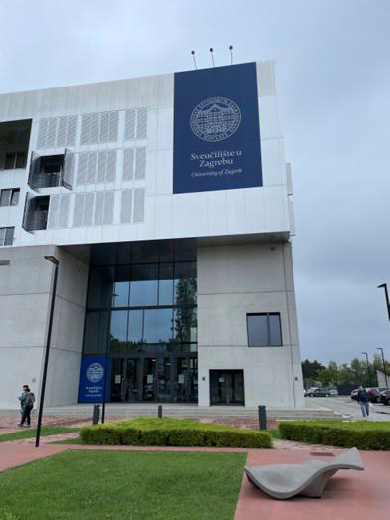
Overall, I was very happy with my faculty. I studied sociology at the Faculty of Croatian Studies. It was located away from the city center, and the campus was an old military base that had been converted into a university campus.
One thing that I really liked were the great cafeteria prices. You could get a main course, a dessert, and a salad or soup for about one euro. The food was very meat-heavy, for example pork or chicken with various side dishes. The vegetarian options were rather limited and sometimes only available on request. Every Friday was fish day, when there was mainly fish instead of meat to choose from. The cafeteria on my campus also had a café that served good coffee. There were also various cafeterias throughout Zagreb where you could eat cheaply anywhere with your student ID. The offerings also varied from location to location. Some of the cafeterias were also open in the evenings, so you never really had to cook, but could always go to the cafeteria. That was really cool.
The lectures were structured similarly to those in Germany. You sat with Erasmus students and Croatian students in a room that, in my faculty, was more reminiscent of a classroom. All lectures and seminars for Erasmus students were held in English, which was actually consistently enforced. In general, the professors were very helpful and really nice. Those responsible for the Erasmus students also took great care of us and helped immediately if there were any problems.
What I thought was cool was the “Risk Society” seminar, which was taught alternately by the Croatian faculty and the KU. That way, I got to see a little bit of home every week via Zoom In general, I felt that the workload was a little lighter than in Eichstätt. I had to earn 30 ECTS credits due to the mandatory semester abroad, but it felt more relaxed because the final exams in Zagreb are divided into two midterms. You have the first midterm after the first half of the semester, so you only have to study half the material. Then at the end of the semester, you have the second midterm, and if you pass both, you don't have to take a final exam. If you fail a midterm or don't take one for another reason, you can also just take one big exam at the end of the semester. The deadlines for assignments are shorter than in Eichstätt. You tend to hand them in at the end of the semester rather than just before the next one, as is usually the case. For me, however, this was actually better, as it meant I had enough time after the end of the semester to do a bit of stress-free traveling. The winter semester lasts roughly the same as in Eichstätt, from October to the beginning of February.
Many courses in Zagreb have comparatively fewer ECTS credits than they would have in Eichstätt, so it is definitely worth having the working hours credited accordingly. However, this worked without any problems for me.
Leisure time and life in Zagreb
As we all know, the best thing about a semester abroad is the friendships you make. And I would totally agree with that! There are accounts on Instagram (esnzagreb or esncroatia) that plan and organize various events and trips for Erasmus students. I would definitely recommend participating in the first Erasmus events, because that's the easiest way to get in touch with others. Towards the end, most people have already formed their groups and you don't mix as much anymore. Rakhia Thursday is also recommended. The Rakhia bar is located on Bar Street (Ulica Ivana Tkalčića) in Zagreb, and every Thursday they offer a beer and a shot of Rakhia for only €3.10. There is usually a large crowd in front of the bar, consisting not only of Erasmus students but also Croatians. So it's the perfect place to make new friends.
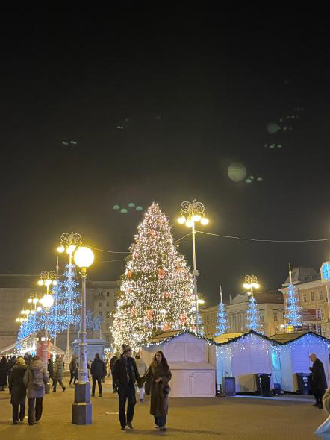
Zagreb has a lively nightlife anyway, especially at Christmas. There were lots of individual Christmas markets scattered throughout Zagreb and there was something going on everywhere. The Christmas season in Zagreb is truly something special that should not be missed! Almost the entire city was decorated with fairy lights, Santa Claus rode through Zagreb in a tram, and a huge ice rink was set up right in the center opposite the main train station. And mulled wine only cost €2.50. But even otherwise, there was always something going on in the bars. There is also a club (Bunker) in the center, which has different themes on different days. Thursdays, for example, were always Fuego nights, where they mainly played Spanish music. Since the club was not far from the bar street, it was naturally tempting to stop by.
But Zagreb also has a lot to offer during the day. The cafés are really nice, and it's totally normal to linger there for several hours. Since I did my Erasmus semester in winter, we didn't sit outside that often. But when the sun shone for even just half an hour, lots of people would sit outside the cafés with their coffee or tea. Zagreb also has a few unique museums, such as the Museum
of Broken Relationships, the Museum of Hangovers, and the Museum of Unfinished Art. These cost a little more to enter, but are definitely worth a visit!
The city's location is also great. You can get almost anywhere in the Balkan region in under 6 hours with the FlixBus. So there's nothing stopping you from taking weekend trips! I can especially recommend Split at the beginning of the winter semester, as it's still a bit warmer there, but it's already off-season. That means accommodation is cheaper and the city isn't overcrowded. However, you have to accept that not everything will be open. Otherwise, cities such as Budapest and Belgrade are not far away, both of which are very nice destinations. I think if you go to Zagreb during the summer semester, the city will be different again and probably even busier than it was when I was there.
Nevertheless, I was very happy in Zagreb and am really glad that I was assigned to this city. It takes a little time to get used to it at first, but then Zagreb is a city that you can't help but fall in love with!