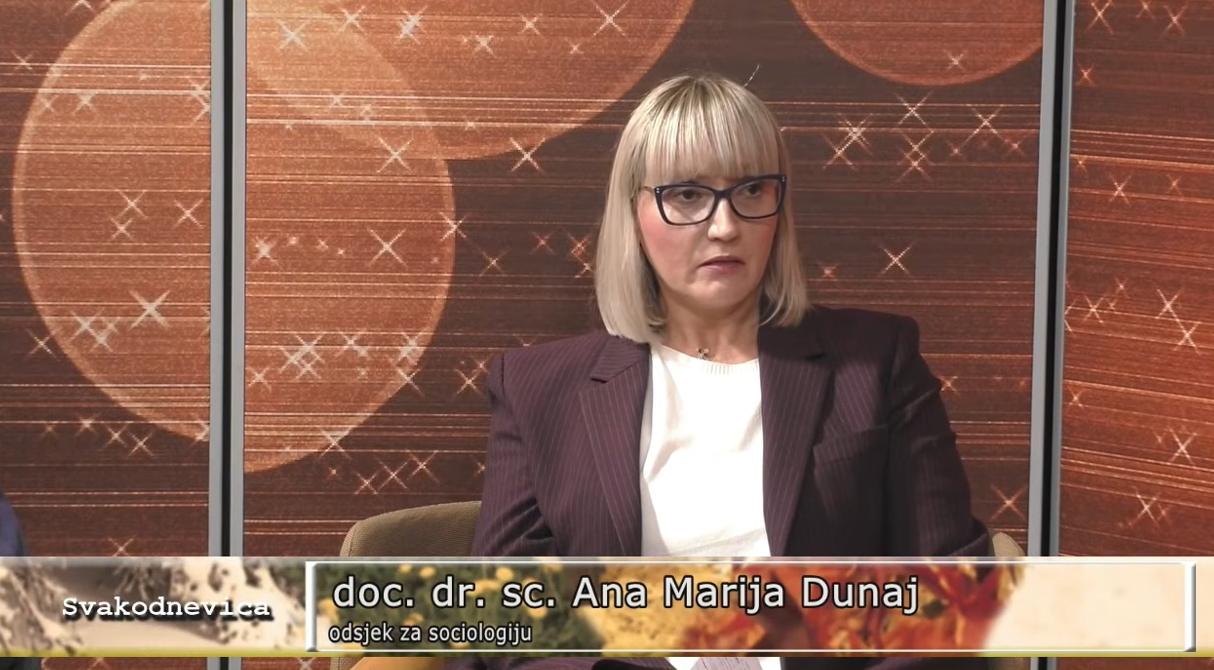
Photo: Screenshot from the TV programme Svakodnevica, OTV
Assistant Professor Ana Marija Dunaj, PhD, from the Department of Sociology at the Faculty of Croatian Studies, University of Zagreb, appeared on the programme Svakodnevica on Otvorena televizija Zagreb (OTV) on Monday, 16 November. The programme focused on digital inclusion and exclusion in the 21st century, with particular emphasis on the challenges faced by vulnerable social groups and the role of academia and local communities in ensuring equal opportunities to access digital services. Dunaj was joined by Luka Holjevac, a member of the Gornja Dubrava City District Council.
Presenting research conducted as part of the institutional project DIGI-HR – Dimensions of Digital Exclusion and Inclusion in the Republic of Croatia, Dunaj emphasised that digital exclusion is not limited to a lack of access to the internet and digital devices. It also involves insufficient digital skills, financial resources, trust, and support in using digital services.
 She particularly highlighted findings from a survey of 1,083 adults, which showed that 44.3% of respondents use generative artificial intelligence tools such as ChatGPT and Gemini. The results revealed significant differences according to age, education, and income. Among respondents aged 18 to 29, 73% reported using AI tools, compared with 24% of those aged 60 to 74.
The discussion also addressed the relationship between the use of digital technologies and social inclusion, highlighting the importance of distinguishing statistical correlations from causal relationships.
As an example of connecting scientific research with practical initiatives, Dunaj presented educational workshops organised by members of the DIGI-HR project team in cooperation with the Zagreb Centre for Independent Living. The workshops cover topics such as artificial intelligence, social media, digital etiquette, identifying disinformation, and using the e-Citizens (e-Građani) system.
The discussion also explored opportunities for cooperation between academia, local government, and other institutions in organising educational activities and providing accessible spaces where citizens could use digital public services independently or with assistance.
The full programme is available to watch on the YouTube channel of Zagrebancija and OTV.
.png)


 Pristupačnost