


 Pristupačnost
The Department of Sociology was established in 1992 and is one of the core disciplines of the Faculty of Croatian Studies. The concept of sociology studies focuses on the application of sociological theories and social science methodology for understanding social processes and phenomena in the specific context of Croatian society and comparatively in a European and global perspective. The study of sociology aims to train highly qualified sociological research personnel with professional research and analytical skills necessary for productive work in the public and private sectors. The sociology program at the bachelor's and master's levels is organized according to current international scientific standards.

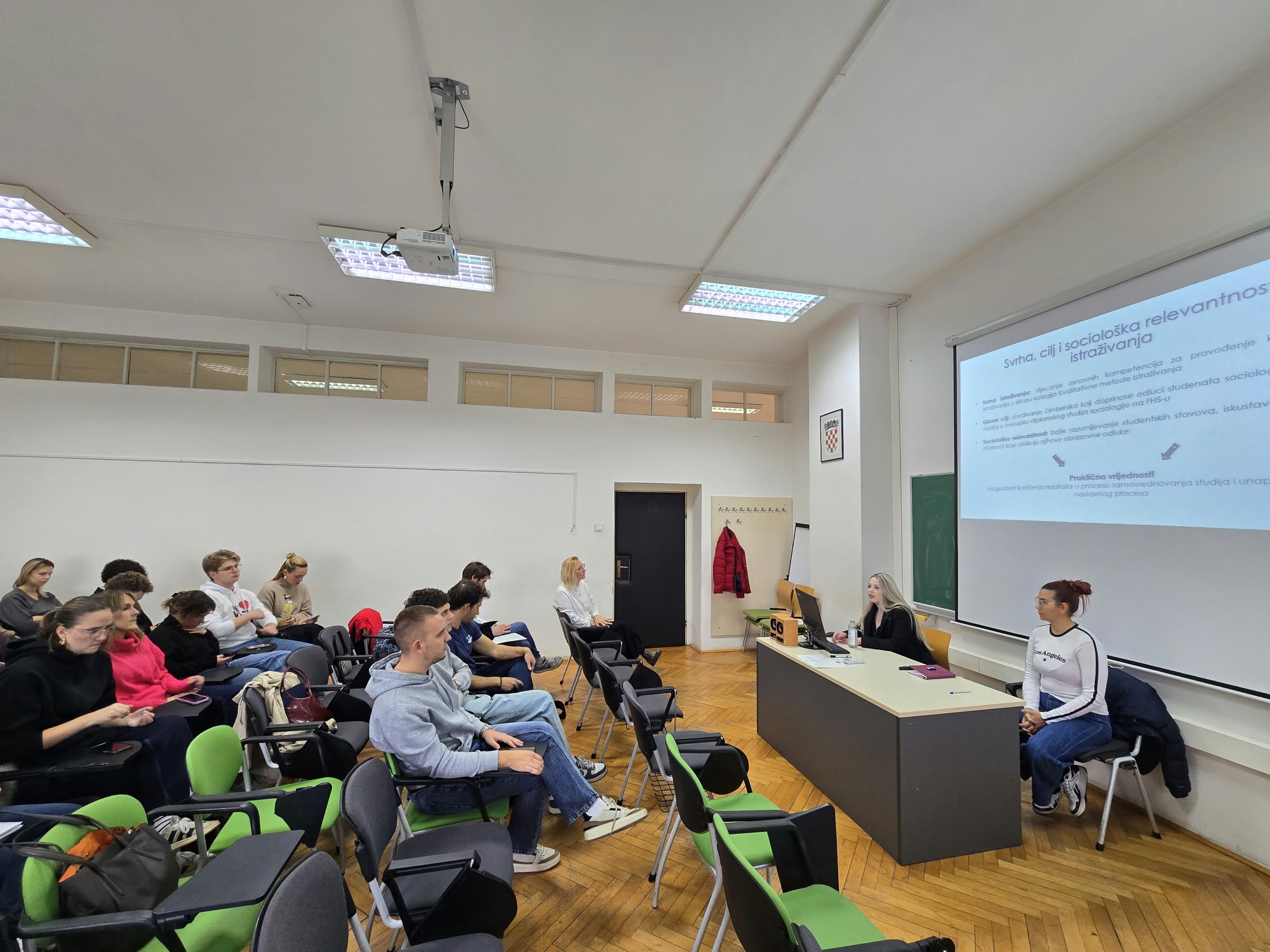
On Thursday, 5 November, Lucia Diminčić, Ana Funarić, Fedra Pervan, Ana Zara Popec and Natanel Stepanić, all second-year master’s students in sociology at the Faculty of Croatian Studies, spoke to students on the Social Research Methodology course. The audience were second-year undergraduates who had learned about interviewing the previous week. This time, they heard first-hand what it was like for their peers to conduct their own research. The master’s students carried out the study during the summer semester of the previous academic year as part of the Qualitative Research Methods course. Associate Professor Marica Marinović Golubić presented the findings.
The student researchers wanted to understand what influences their peers’ decision to stay at the Faculty to study sociology after completing their undergraduate degree. They used their research questions to develop discussion guides, then conducted nine semi-structured interviews with undergraduates and two focus groups with master’s students. They described how they transcribed the recordings, coded the responses and identified recurring themes. They also recommended software to help with transcription and data analysis.
The speakers discussed how they handled brief answers and long pauses during interviews. Sometimes a follow-up question encouraged participants to say more about their experience. At other times, it helped to give them a moment to think. For focus groups, the speakers advised students to note how participants responded to one another. Paying attention to where people disagreed or built on someone else’s point helped them understand how the discussion unfolded. If they were to repeat the study, they said, they would take more care to choose a quiet room and test the sound before recording. They realised how much this mattered when they began transcribing the conversations.
Presenting the findings, Professor Marinović Golubić noted that good relationships with teaching staff were among the main reasons students gave for staying at the Faculty to study sociology. Master’s students particularly valued working in small groups. When asked what they would improve, participants said they wanted more opportunities to put what they had learned into practice. Students on dual-subject programmes also wanted clearer information about their options for master’s study. Professor Marinović Golubić recommended that the Department explain these options more clearly and that teaching staff continue to set aside time to work with students individually.
.jpeg)