


 Pristupačnost
The Department of Sociology was established in 1992 and is one of the core disciplines of the Faculty of Croatian Studies. The concept of sociology studies focuses on the application of sociological theories and social science methodology for understanding social processes and phenomena in the specific context of Croatian society and comparatively in a European and global perspective. The study of sociology aims to train highly qualified sociological research personnel with professional research and analytical skills necessary for productive work in the public and private sectors. The sociology program at the bachelor's and master's levels is organized according to current international scientific standards.
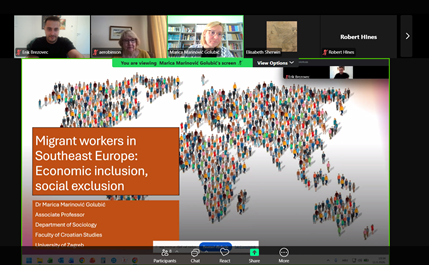
On 11 June, the Department of Sociology at the Faculty of Croatian Studies, University of Zagreb, organized the international online roundtable “Migrant Workers in Southeast Europe – Economic Inclusion, Social Exclusion.”
The roundtable was chaired by Associate Professor Marica Marinović Golubović, PhD, from the Department of Sociology at the Faculty of Croatian Studies. The event was held as part of the institutional research project DIGI-HR and within the framework of international cooperation between the Faculty of Croatian Studies, University of Zagreb, and the University of Arkansas at Little Rock.
In her presentation, Marinović Golubović discussed the latest findings on the growing arrival of workers from South and Southeast Asia to countries in Southeast Europe, with a particular focus on Croatia. She emphasized that Croatia has been experiencing a significant labour shortage in recent years, driven by demographic ageing and the emigration of domestic workers to more developed European Union member states. Under these circumstances, migrant workers from Nepal, India, Bangladesh, Pakistan, and the Philippines have become an increasingly important part of the Croatian labour market.
Special attention was devoted to the role of employment agencies that act as intermediaries between foreign workers and Croatian employers. It was highlighted that many migrant workers arrive after incurring substantial financial costs and debts, which often place them in a vulnerable position and increase their dependence on employers and recruitment agencies.
 Participants also discussed the social dimensions of migrant workers’ integration. While migrant workers are generally successfully integrated into the labour market and help address critical labour shortages in sectors such as construction, tourism, hospitality, transport, and delivery services, their social integration remains a significant challenge. Key barriers identified included language difficulties, limited access to information and institutions, social isolation, and a lack of contact with the local population outside the workplace.
The presentation also featured findings from recent research conducted by the Department of Sociology at the Faculty of Croatian Studies, focusing on the everyday experiences of migrant workers, digital inclusion and exclusion, the experiences of foreign drivers and delivery workers, and representations of migrant workers on social media.
Following the presentations, a highly engaging and constructive discussion took place, bringing together participants from Croatia and abroad to exchange experiences and perspectives on current migration trends, integration challenges, and potential directions for future research.