

 Pristupačnost
The Department of Sociology was established in 1992 and is one of the core disciplines of the Faculty of Croatian Studies. The concept of sociology studies focuses on the application of sociological theories and social science methodology for understanding social processes and phenomena in the specific context of Croatian society and comparatively in a European and global perspective. The study of sociology aims to train highly qualified sociological research personnel with professional research and analytical skills necessary for productive work in the public and private sectors. The sociology program at the bachelor's and master's levels is organized according to current international scientific standards.
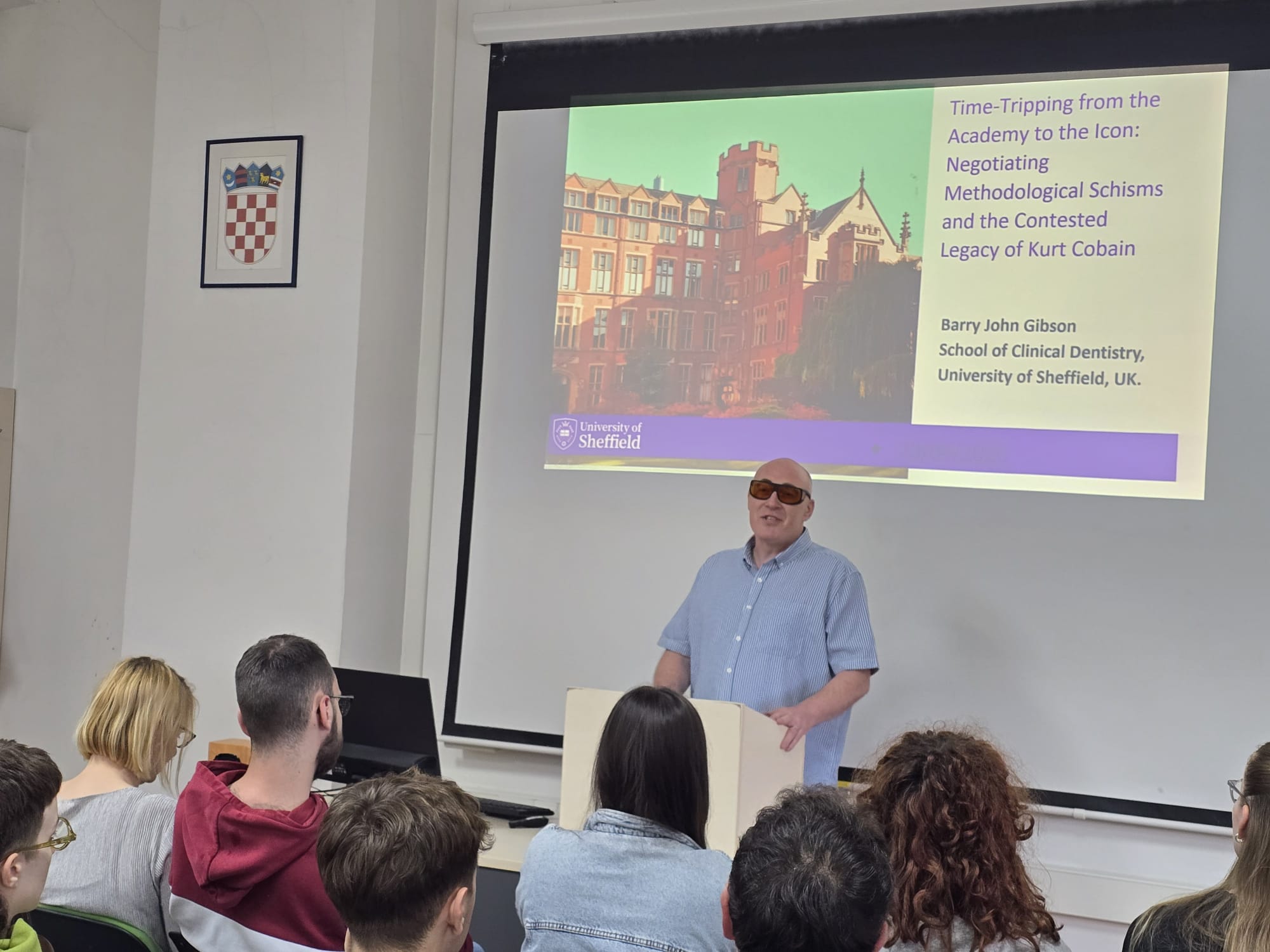
Today, the Faculty of Croatian Studies hosted a guest lecture by Prof. Barry J. Gibson from the University of Sheffield entitled “Time-Tripping from the Academy to the Icon: Negotiating Methodological Schisms and the Contested Legacy of Kurt Cobain,” organized as part of the institutional research project DIGI-HR.
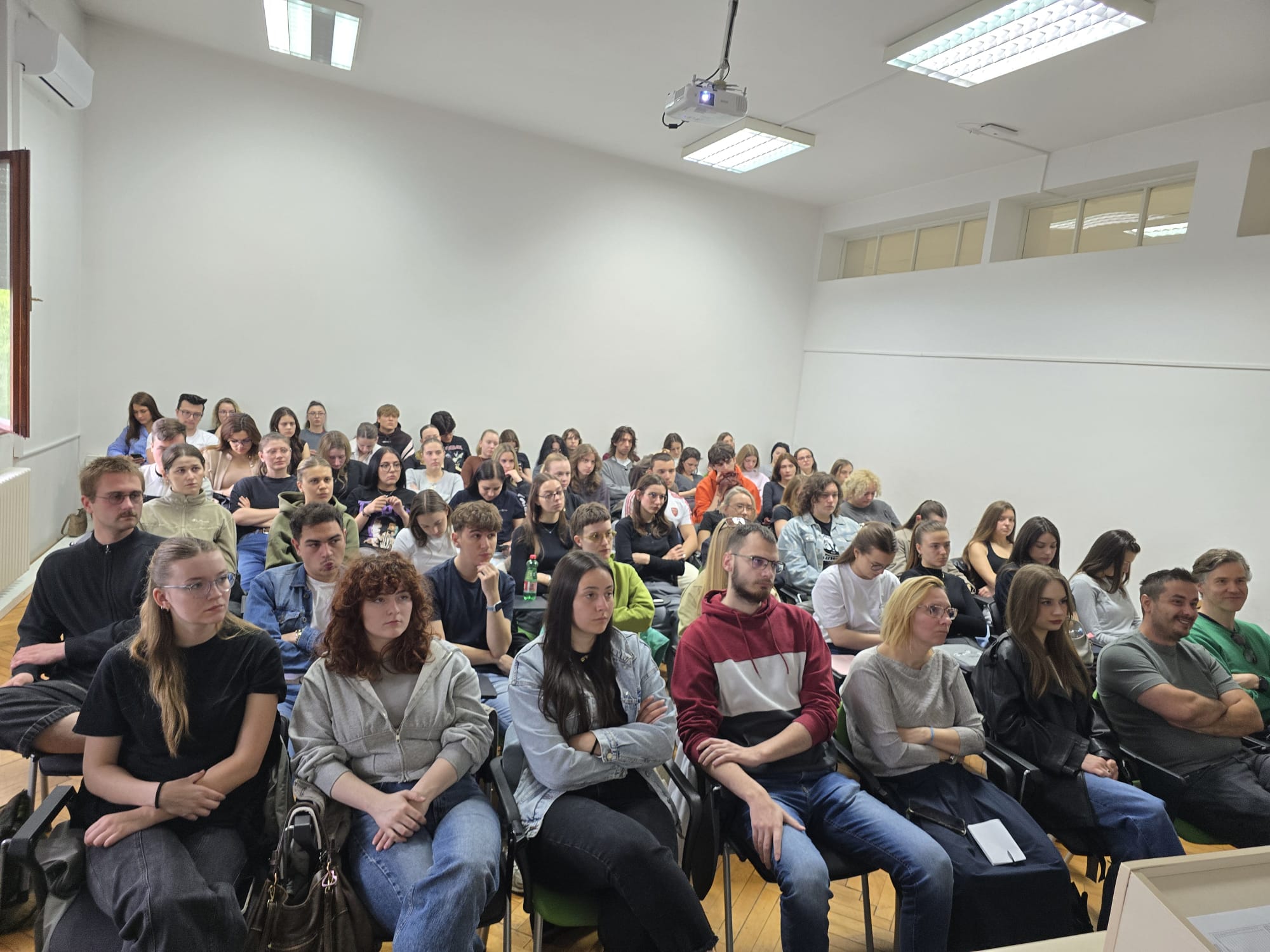
The strong interest in the lecture was evident even before it began – the Šibenik lecture hall was filled to capacity, with additional attendees searching for available seats. The event brought together sociology students, faculty members, and members of the DIGI-HR research team.
In his lecture, Prof. Gibson explored the relationship between history and collective memory, demonstrating how social groups continually reinterpret past events from the perspective of present-day social circumstances. At the center of his talk was the concept of time-tripping, which he used to explain how the past is reconstructed and adapted to contemporary social needs, values, and conflicts.
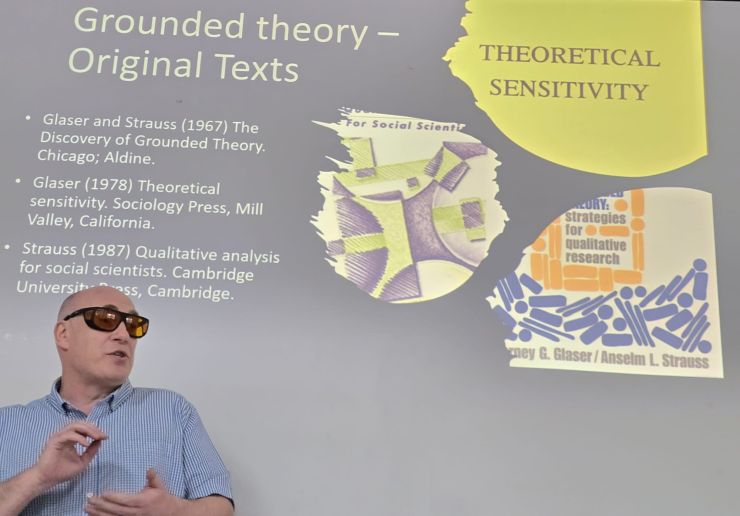
 The first part of the lecture focused on the development of grounded theory, one of the key qualitative methodologies in the social sciences. Prof. Gibson outlined its historical development, internal theoretical disputes, and contemporary methodological directions, emphasizing how academic debates on methodology often reflect broader transformations within the social sciences and humanities.
Particular attention was given to the case of Kurt Cobain, through which Prof. Gibson illustrated how social memory is shaped through personal, media, and cultural narratives. By examining memoirs and biographical accounts from people who were part of Cobain’s personal and professional life, he raised the question of who participates in constructing a person’s historical legacy and how competing interpretations shape socially accepted versions of the past.
Prof. Gibson also emphasized the importance of understanding how societies create and sustain historical narratives, especially in the context of divided and post-conflict communities. Through examples of contemporary social conflicts, he demonstrated how collective memory can play a significant role in shaping social identities, political attitudes, and relationships to the past.
Students took the opportunity to engage in discussion with the guest lecturer and gain firsthand insights into the relationship between history and collective memory, as well as the role of popular culture in shaping collective narratives.
Prof. Gibson’s lecture was the second in a series of international guest lectures organized within the DIGI-HR project. Earlier this week, on Tuesday, May 5, the Faculty of Croatian Studies also hosted a guest lecture by Prof. Christian Morgner from the University of Portsmouth on generative artificial intelligence as a “laboratory of questions,” continuing the DIGI-HR project’s commitment to fostering interdisciplinary discussions on contemporary social and technological transformations.