Opcije pristupačnosti Pristupačnost

About Us

History classes at the Faculty of Croatian Studies of the University of Zagreb began during the 1997/1998 academic year. Currently, the Department of History offers classes at the undergraduate, graduate and postgraduate (doctoral) levels of study. 

History studies at our faculty are organized according to the contemporary scientific and didactic standards. Over the course of the past academic years, our program undeqent a transition in order to adapt its own study program to students who whish to learn more about national history. The fundamental feature of our program is the strong connection with other national historical institutions (museums, Croatian Institute of History, etc.). This fact allows students to start modeling their own research interest in the areas of national history that interest them already during their undergraduate studies. At the graduate level, students are provided with thematic specialization through a large number of non-mandatory courses. 

Although our program emphasizes Croatian history, it also includes the posibilitiy of profiling in various areas of world history: from ancient civilizations and societies to modern and contemporary history. This kind of profiling is open to students due to the wide topics of courses that are adapted to the various interests of students. 

10/09/2026

Field Class for the Local History Course in Virovitica and Voćin

As part of the course Local History, led by Associate Professor Vlatko Smiljanić, PhD, and taught by Alen Moslavac, MA in Hungarian Philology and History Education, a field class was held in Virovitica and Voćin on 23 January 2026. The field class was attended by students from different years of study who are enrolled in the course.

The programme began with the departure from Zagreb at 7:00 a.m., while the first part of the field class took place in Virovitica. The students visited the Virovitica City Museum, located in the Pejačević Castle, where they were guided through the permanent exhibition by Sanja Baškarad, curator of the Archaeology Department. Particular attention was devoted to the historical development of the Virovitica area from the Palaeolithic period to the present day, as well as to the interactive section of the Museum, which combines educational and entertaining content. The students also had the unique opportunity to learn about the creation of the Museum’s new permanent exhibition, completed in the summer of 2019.

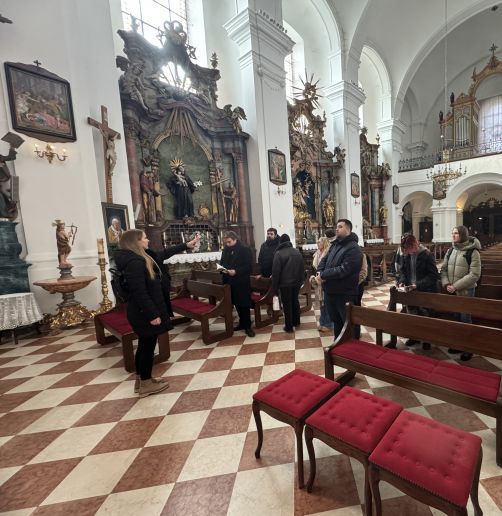
The programme continued with a visit to the monastery and parish church of St Roch and the Monastery Museum. The tour was led by Nikolina Hečimović, curator of the Cultural History Department of the Virovitica City Museum, with the participation of the Guardian, Friar Ivica Jagodić. The presentation covered the history of the monastery, its sacred heritage, and the role of the Franciscans in the cultural and social life of Virovitica and the wider region. Particular emphasis was placed on the church’s nine altars, one of the most important achievements of Baroque art in north-western Croatia. The curator also provided the students with museum exhibition catalogues and instructed them on how to formulate research topics for future master’s theses.

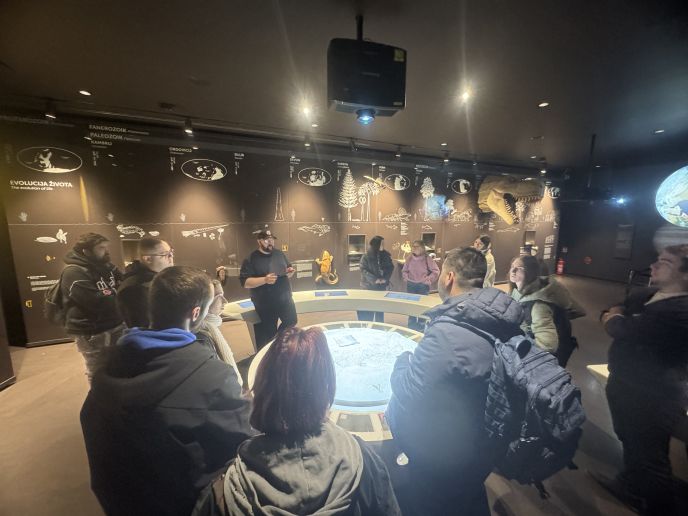
After their visit to Virovitica, the students continued their field class in Voćin with a visit to the Geo-Information Centre of Papuk Nature Park. Guided by the institution’s staff, they toured the permanent exhibition, with particular attention paid to the section dedicated to the cultural and historical heritage of the Papuk area and western Slavonia, as well as to the ecological-historical approach that connects the natural and social histories of the region.

This was particularly useful for understanding Papuk as a natural gem containing great riches — from its natural wonders, biodiversity and historical heritage to its abundant flora and fauna on the surface, as well as archaeological and fossil remains hidden in its fertile soil.

The field class enabled the students to gain first-hand insight into the material remains of local history, connect theoretical content with examples encountered in the field, and become acquainted with the work of museums and heritage institutions. In this way, the principal aim of the course was achieved: to develop an interest in researching one’s own local history, which is yet to take shape as a distinct branch of historical scholarship.

Like the course itself, which was characterised by interdisciplinarity, the field class encompassed topics ranging from archaeology and ethnology to geography and sociology, providing students with a broader understanding of local history. The field trip also marked the conclusion of the Local History course in the winter semester, as it represented the final lecture and the end of teaching for the semester.

Text: Dora Frajt


News list