
Opcije pristupačnosti Pristupačnost

About Us

History classes at the Faculty of Croatian Studies of the University of Zagreb began during the 1997/1998 academic year. Currently, the Department of History offers classes at the undergraduate, graduate and postgraduate (doctoral) levels of study. 

History studies at our faculty are organized according to the contemporary scientific and didactic standards. Over the course of the past academic years, our program undeqent a transition in order to adapt its own study program to students who whish to learn more about national history. The fundamental feature of our program is the strong connection with other national historical institutions (museums, Croatian Institute of History, etc.). This fact allows students to start modeling their own research interest in the areas of national history that interest them already during their undergraduate studies. At the graduate level, students are provided with thematic specialization through a large number of non-mandatory courses. 

Although our program emphasizes Croatian history, it also includes the posibilitiy of profiling in various areas of world history: from ancient civilizations and societies to modern and contemporary history. This kind of profiling is open to students due to the wide topics of courses that are adapted to the various interests of students. 

10/09/2026

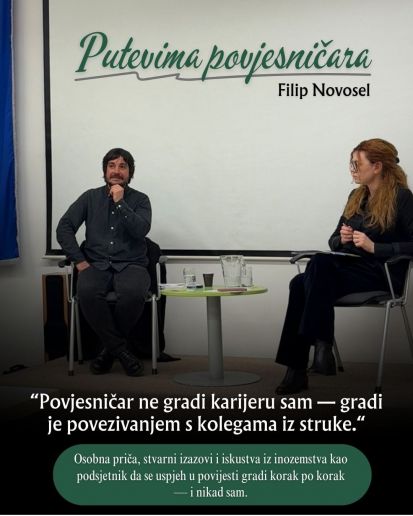
“Following the Historians’ Paths”: Dr Filip Novosel on Studying at Croatian Studies, Scholarly Development, Work and the Challenges of the Profession

On Tuesday, 16 December, Dr Filip Novosel, a former student of the Faculty of Croatian Studies and currently a researcher at the Croatian Institute of History, delivered a guest lecture in the Faculty Library. The lecture was part of a new series of guest lectures and discussions organised by the Student Society of History “Ivan Lučić – Lucius”.

Drawing on his own experiences of studying history, serving as president of the Student Society of History “Ivan Lučić – Lucius”, finding employment after graduation and going abroad, he shared honest and valuable advice with students and future historians. He particularly emphasised the importance of networking with colleagues in the field, perseverance in one’s work, and taking advantage of opportunities to participate in international projects and professional conferences during one’s studies and later career.

The discussion was inspiring and offered a realistic insight into the challenges of the historical profession, ways of addressing them, as well as the many advantages of working as a historian. At the end of the event, Dr Novosel answered questions from the students. The event was organised as part of the elective course The Historian’s Craft at the Department of History.

We would like to thank our guest for taking part and look forward to the next lectures in the “Following the Historians’ Paths” series!

Photographs and text: Barbara Štimac

Filip Novosel graduated in 2010 from the double-major undergraduate programme in History and Croatology at the University of Zagreb’s Croatian Studies. In the 2011/2012 academic year, he earned a Master of Arts degree in Central European History from Central European University in Budapest. In 2019, he received his PhD from the postgraduate doctoral programme in Early Modern History at the Faculty of Humanities and Social Sciences, University of Zagreb.

He has been employed at the Croatian Institute of History since 2013, first as a research assistant and senior research assistant, and since 2023 as a research associate. He has participated in numerous research projects supported by the Republic of Croatia.

His scholarly interests focus on the social, urban and military history of the early modern period, primarily in the eastern Adriatic region, with particular emphasis on archival sources preserved at the State Archives in Zadar and the Archivio di Stato di Venezia. His work to date has resulted in the publication of around thirty scholarly and professional articles in Croatian and international journals, edited volumes and books. He has also edited collections of sources in the Croatian Academy of Sciences and Arts’ series Monumenta spectantia historiam Slavorum Meridionalium, and has served as an editor of books and the journal Historijski zbornik.

In 2024, he published the monograph Life in a Dalmatian City in the Seventeenth Century: Society and Everyday Life in Zadar against the Background of Military Events during the War of Candia (1645–1669). He has participated in around fifteen scholarly conferences in Croatia and abroad and occasionally gives public talks and lectures at faculties and other cultural and scholarly institutions.

He is the head of the Zagreb Secondary-School History Teachers’ Initiative, organised in cooperation between the Croatian Institute of History and the Education and Teacher Training Agency, and secretary of the Research Group for the Study of the Eighteenth Century in the Croatian Lands (IGOS). He has also taken part in radio and television programmes aimed at popularising science.

In 2018, his work was recognised with the State Award for Science for young researchers in the humanities. In 2025, he received the “Tadija Smičiklas” Award, together with Dr Lovorka Čoralić, for the publication of archival material.


News list