
Opcije pristupačnosti Pristupačnost

About Us

History classes at the Faculty of Croatian Studies of the University of Zagreb began during the 1997/1998 academic year. Currently, the Department of History offers classes at the undergraduate, graduate and postgraduate (doctoral) levels of study. 

History studies at our faculty are organized according to the contemporary scientific and didactic standards. Over the course of the past academic years, our program undeqent a transition in order to adapt its own study program to students who whish to learn more about national history. The fundamental feature of our program is the strong connection with other national historical institutions (museums, Croatian Institute of History, etc.). This fact allows students to start modeling their own research interest in the areas of national history that interest them already during their undergraduate studies. At the graduate level, students are provided with thematic specialization through a large number of non-mandatory courses. 

Although our program emphasizes Croatian history, it also includes the posibilitiy of profiling in various areas of world history: from ancient civilizations and societies to modern and contemporary history. This kind of profiling is open to students due to the wide topics of courses that are adapted to the various interests of students. 

10/09/2026

Field Class for History Students – Ethnographic Museum

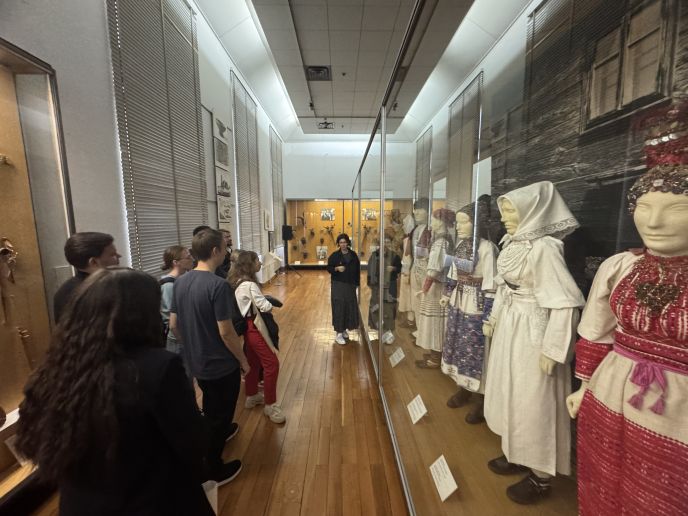
As part of the course Local History, led by teaching assistant Alen Moslavac, students of the Department of History took part in a field class held at the Ethnographic Museum on Friday, 31 October 2025. Guided through the Museum’s permanent exhibition by senior curator and educator Silvija Vrsalović, the students had the opportunity to learn about traditional clothing from Croatia dating from the late nineteenth and the first half of the twentieth century, which faithfully reflects the symbolic values of the society of that period.

The exhibition conveyed the regional differences of the Republic of Croatia, as well as social, age-related, gender-based and economic distinctions. It includes collections ranging from lacework, rugs and blankets to traditional costumes from all parts of Croatia, musical instruments, and objects associated with customs and beliefs.

The students learned how traditional culture reflects the way people lived in the past and their relationship with nature and the community. Through the displayed traditional costumes, tools, furniture and ritual objects, they became acquainted with the various regions of Croatia and their particular features. They also learned how customs, beliefs and handicrafts were passed down from one generation to the next and preserved as part of intangible cultural heritage. In this way, they developed an understanding of the value of cultural heritage and its importance in contemporary society.

For the students, this was a particularly valuable experience, as it enabled them to learn how people in their local communities lived in the past — how they dressed, what occupations they pursued, what they believed in and how customs changed over time. Such knowledge connects the history of everyday life with local identity and tradition. Museum objects and stories make it easier to recognise the continuity between the past and the present, enabling students to identify traces of tradition in contemporary life in their own communities.

The Ethnographic Museum thus helps foster a sense of belonging, respect for heritage and awareness of the importance of its preservation. In the context of local history, this means that history is learned not only through major events, but also through the lives of ordinary people — their work, values and culture.

In addition to the permanent exhibition, the students also had the opportunity to visit two temporary exhibitions: Travellers (Putnici), curated by Marija Živković, which follows the journeys of people and objects from the colonial period to the present day and examines the circumstances in which the Collection of Non-European Cultures was created; and From Wall to Wall – From Embroidered to Virtually Shared Values (Sa zida na zid – od vezenih do virtualno dijeljenih vrijednosti), curated by Gordana Viljetić.

The latter exhibition presents a collection of traditional embroidered wall hangings from the Ethnographic Museum’s Household Textiles Collection, exploring their origins and distribution, methods of production, themes and, above all, their rich layers of meaning. It aims to use this traditional object as a starting point for examining contemporary everyday life in the context of digital culture.


News list