Opcije pristupačnosti Pristupačnost

About Us

History classes at the Faculty of Croatian Studies of the University of Zagreb began during the 1997/1998 academic year. Currently, the Department of History offers classes at the undergraduate, graduate and postgraduate (doctoral) levels of study. 

History studies at our faculty are organized according to the contemporary scientific and didactic standards. Over the course of the past academic years, our program undeqent a transition in order to adapt its own study program to students who whish to learn more about national history. The fundamental feature of our program is the strong connection with other national historical institutions (museums, Croatian Institute of History, etc.). This fact allows students to start modeling their own research interest in the areas of national history that interest them already during their undergraduate studies. At the graduate level, students are provided with thematic specialization through a large number of non-mandatory courses. 

Although our program emphasizes Croatian history, it also includes the posibilitiy of profiling in various areas of world history: from ancient civilizations and societies to modern and contemporary history. This kind of profiling is open to students due to the wide topics of courses that are adapted to the various interests of students. 

10/09/2026

Dr Nikolina Šimetin Šegvić had Two Presentations at Events Commemorating the 1,100th Anniversary of the Kingdom of Croatia

Dr Nikolina Šimetin Šegvić, a teaching assistant at the Department of History, took part on Wednesday, 22 October 2025, in the lecture series Rex et Regnum, organised to mark the 1,100th anniversary of the Kingdom of Croatia. The lecture series is organised by the Department of History and the Department of Fine Arts of Matica hrvatska. The title of her lecture was “Duvno Field between Historiography, a Site of Memory and Myth”. The other lectures in the series were delivered by Dr Ante Birin (Croatian Institute of History), Dr Mario Jareb (Croatian Institute of History) and Dr Ivan Kokeza (Croatian History Museum).

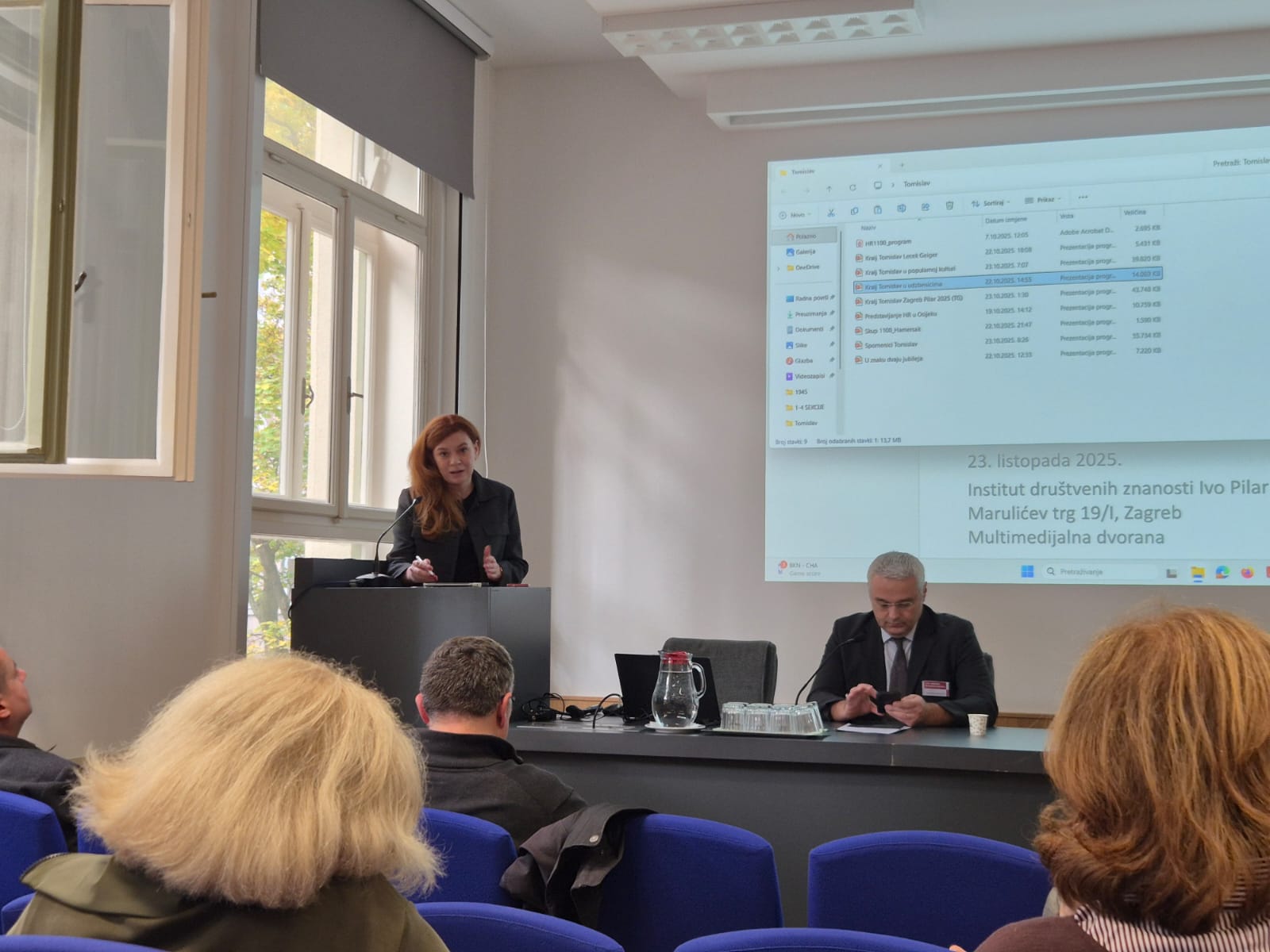
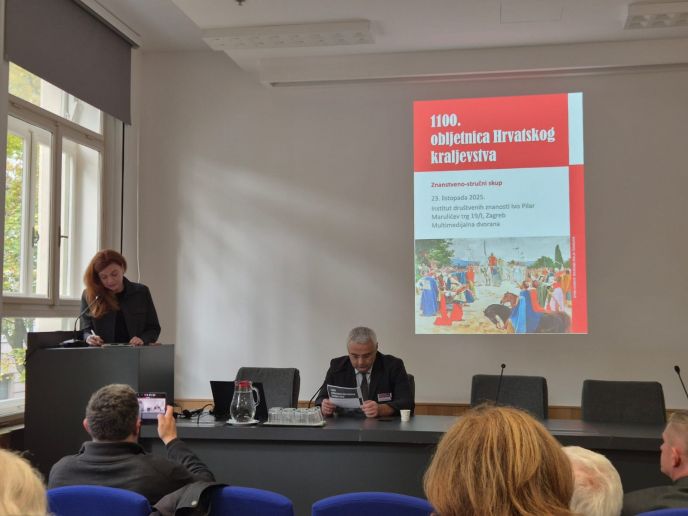
The following day, 23 October 2025, Dr Nikolina Šimetin Šegvić also took part in the scholarly and professional conference “The 1,100th Anniversary of the Kingdom of Croatia”, held at the Ivo Pilar Institute of Social Sciences, where she once again presented the same topic, “Duvno Field between Historiography, a Site of Memory and Myth”. The conference featured 14 speakers, including Professor Emerita Mirjana Matijević Sokol, a former head of the Department of History at the Faculty of Croatian Studies. The conference was organised by the Ivo Pilar Institute of Social Sciences in cooperation with the Croatian Institute of History, the Miroslav Krleža Institute of Lexicography, the Department of History of the Faculty of Humanities and Social Sciences at the University of Zagreb, the Institute for Historical and Social Sciences of the Croatian Academy of Sciences and Arts in Zagreb, the Croatian National Committee for Historical Sciences, and the Croatian Historical Society.

Dr Šimetin Šegvić’s presentation builds on her article published in Hrvatska revija, no. 4 (2024), a thematic issue dedicated to the forthcoming year 2025, which the Croatian Parliament proclaimed the “Year of Commemorating the 1,100th Anniversary of the Kingdom of Croatia”. This issue of Hrvatska revija was edited by Professor Emerita Mirjana Matijević Sokol as guest editor and represented one of the publications announcing the events and scholarly reflection connected with the 1,100th anniversary of the Kingdom of Croatia.

In her article, presented as part of the Rex et Regnum lecture series at Matica hrvatska and at the scholarly and professional conference held at the Ivo Pilar Institute of Social Sciences, Dr Šimetin Šegvić examines, for the first time in Croatian historiography, the alleged coronation of King Tomislav on Duvno Field as a complex phenomenon at the intersection of historiography, folk tradition and questions of Croatian identity associated with the Duvno Field area. She ultimately analyses the subject through the concepts of cultural memory and sites of memory, proposing a framework for defining and understanding this issue.


News list