

 Pristupačnost
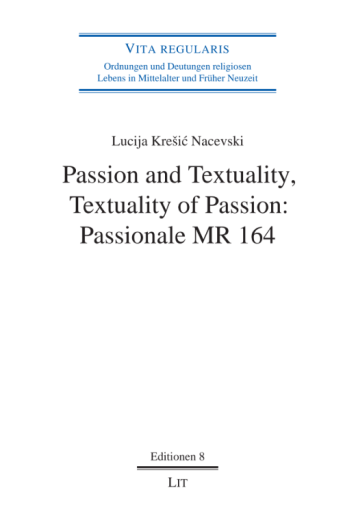
The scholarly monograph Passion and Textuality, Textuality of Passion: Passionale MR 164 by Lucija Krešić Nacevski, PhD, presents an interdisciplinary study of Passionale MR 164, the oldest manuscript codex held in the Metropolitan Library of the Archdiocese of Zagreb. It is also the oldest hagiographical codex preserved in Croatia.
The manuscript consists of two parts: the first contains accounts of the lives and martyrdoms of saints, written in Latin in Carolingian script, while the second is an appended text entitled Vita Marie Egypciace de Greko in Latinum translata (11th century, Split). The Life of Mary of Egypt, appended to the Passionale, is considered the oldest complete text in Croatian literary history written in Latin using Beneventan script.
Through chapters exploring Mediterranean hagiography, early medieval Latin literacy in the territory of present-day Croatia, the Metropolitan Library and its collections, as well as codicological, palaeographical and hagiological analyses of the manuscript, Christian Latin, linguistic features and vocabulary, the author argues that the codex originated in Ravenna in the mid-to-late tenth century.
The monograph also includes transcriptions of relevant passion narratives, including those of St Apollinaris and St Valentine, together with the Life of Mary of Egypt.
The book was published in Münster, Germany, by LIT Verlag, a leading German academic publisher. The volume was edited by Mirko Breitenstein, PhD (Director of the Research Centre for Comparative History of Religious Orders – FOVOG, at TU Dresden), and Gert Melville, PhD (Director Emeritus and member of the Pontifical Committee for Historical Sciences).
Passion and Textuality, Textuality of Passion: Passionale MR 164
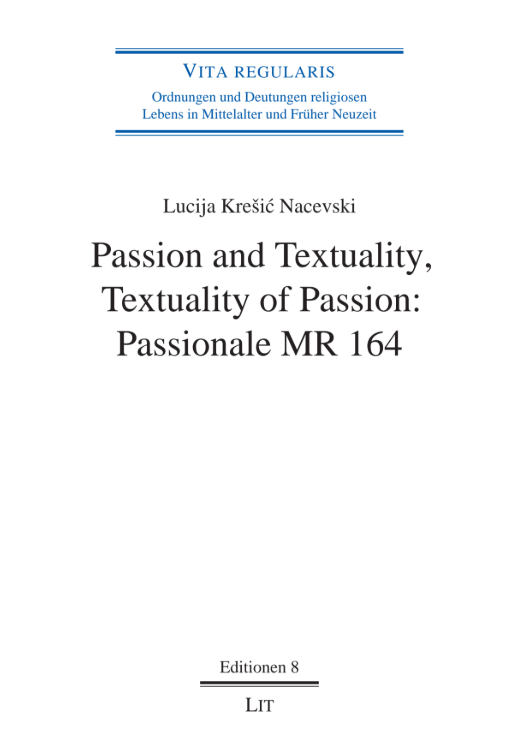
The edited volume Humanitas consolatur, edited by Lucija Krešić Nacevski and Vojislav Sarakinski, was published in 2025 by the Faculty of Philosophy, Ss. Cyril and Methodius University in Skopje.
Excerpt from the Introduction:
“The phrase in the title, humanitas consolatur, was used by Cicero in a letter to his friend Appius Claudius Pulcher during a particularly difficult time in his life. While Cicero was away in Cilicia, his daughter Tullia married Dolabella, who, in turn, was prosecuting Appius under the lex maiestatis. In this context, Cicero writes that Appius' humanitas was a genuine source of comfort to him throughout that period, and he thanks his friend warmly for the support.
If the term humanitas had consistently meant “consolation” throughout the entirety of Roman and later Latin literature, medieval and early modern alike, there would never have been any need for a volume such as this. It is precisely the richness and variability of its meaning, shifting from period to period, genre to genre, author to author, and so on, that has made the term so conceptually challenging. This very complexity has drawn the full attention of the editors of the present volume, who have brought together this collection of essays by our esteemed colleagues, all centered on the exploration of a single, yet remarkably multifaceted concept: humanitas [...] That the question of humanitas remains urgently relevant today is evident in everyday life – in the people we meet and speak with, the films we watch, the books we read, the institutions we attend. [...] We are all too familiar with the attitude found in every period of human history – that the present age is the worst yet, and that anything of true value lies far behind us. Convinced that this is not the case, we present this volume ad legendum vobis studentibusque, in the hope of recognizing and reaffirming eternal values.”
The editor would like to take this opportunity to express her sincere gratitude to her esteemed colleagues at the Faculty of Croatian Studies whose scholarly contributions have enriched this volume.