

 Pristupačnost
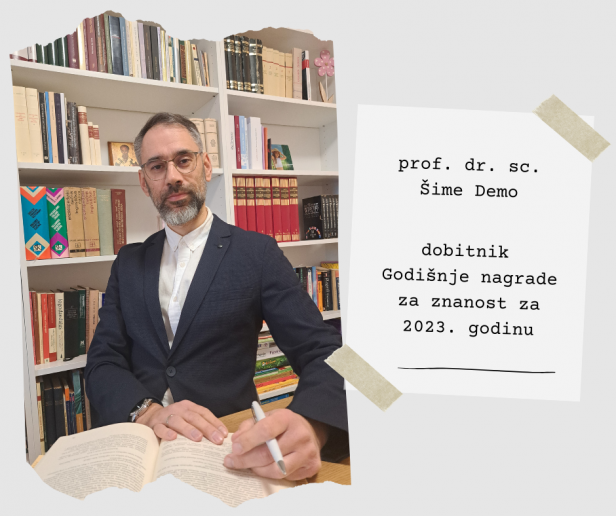
Professor Šime Demo, PhD, has received numerous prestigious honours, most notably the 2023 Annual State Award for Science and the Croatian Academy of Sciences and Arts Award for Outstanding Scientific and Artistic Achievements in 2022. The occasion for our conversation is his latest recognition, awarded for his monumental monograph An Introduction to Latin Macaronic Literature. In this interview, Professor Demo reflects on his achievements, discusses the sources of inspiration behind his research, and explains how his projects contribute to the academic community and society at large. We also explore the challenges facing the humanities in Croatia, his plans for future research, and his advice to aspiring scholars.
Congratulations on receiving another prestigious award for your scholarly achievements. In addition to the Annual State Award for Science, you received the Croatian Academy of Sciences and Arts Award for Outstanding Scientific and Artistic Achievements last year. How do you feel about your work being recognised at such a high level, and what was your reaction to receiving the 2023 Annual State Award for Science?
Although awards are certainly not the primary motivation for pursuing academic research, I cannot deny that receiving these two distinctions has filled me with satisfaction and pride. The Academy's award recognises five years of scholarly work, which suggests that my peers believe I have succeeded in maintaining a consistently high standard of research over an extended period, thanks in no small part to the colleagues with whom I have collaborated during that time.
The Annual State Award for Science, on the other hand, was presented to me for my book An Introduction to Latin Macaronic Literature, on which I worked for twelve years, with very few significant interruptions. In this way, I was able to bring a major chapter of my professional life to a particularly satisfying conclusion and embark upon the second half of my career.
Could you briefly explain how your award-winning work contributes to the academic community and society?
I believe that the body of data presented in my survey of macaronic literature will prove valuable to scholars studying early modern European culture.
As regards its contribution to society more broadly, the humanities, particularly disciplines concerned with the past, face the difficulty that their impact cannot be identified or measured directly. Such an impact becomes apparent only over time and results from the cumulative effect of numerous smaller contributions. It is only through the continuous cultivation of ourselves and our communities, by conducting high-quality research and subsequently disseminating its findings, that our work becomes beneficial to society as a whole.
If the pan-European, and indeed global, phenomenon of early modern Latin culture were to become recognised in public and educational discourse as an indispensable component of the cultural identity of our region, I would consider that a significant achievement arising from our scholarly efforts.
On a more immediate level, the media attention associated with awards of this kind increases the visibility of the disciplines in which we work, as well as that of our home institutions — in my case, the Faculty of Croatian Studies.
Which aspect of your scholarly work would you identify as particularly significant in securing this award, and why do you believe it was recognised?
The official citation describes the award-winning monograph as unique both nationally and internationally. Indeed, the last comparable work was published by Octave Delepierre in the mid-nineteenth century. Since then, several surveys of individual national traditions have appeared, but no comprehensive synthesis of Latin macaronic literature had been published before my book.
I believe this was one of the principal reasons why the Committee for the Awarding of State Prizes for Science considered the study worthy of recognition.
The year 2023 was particularly productive for you professionally, especially with the publication of An Introduction to Latin Macaronic Literature, for which you received the Annual State Award for Science. What initially inspired you to investigate this distinctive literary form?
After completing my doctorate in Latin syntax in 2008, and having also published extensively on early modern Latin literature, I began looking for a topic for my postdoctoral research. My aim was to bring together the two areas in which I had been working: language and literature.
When Professor Darko Novaković suggested macaronic literature, I was immediately enthusiastic, as this genre is distinctive precisely because of the language it employs — an unusual mixture of Latin and a vernacular language. Moreover, macaronic literature remains relatively under-researched. It is also humorous and endlessly entertaining, while at the same time being remarkably perceptive and profound.
I soon received a research fellowship to work at the Seminarium Philologiae Humanisticae at KU Leuven in Belgium, and several years later at the Ludwig Boltzmann Institute for Neo-Latin Studies in Innsbruck. These are leading centres for the study of early modern Latin culture, with extensive collections of relevant literature and highly knowledgeable colleagues who were able to assist me.
The Faculty granted me research leave for these visits, enabling me to devote myself fully to my work and make the most of the time available.
What motivated you to pursue academic research at the Faculty of Croatian Studies, University of Zagreb, and which research topics are of particular interest to you?
I have been teaching at our institution since 2002, initially as an external lecturer. In 2010, I moved from the Croatian Institute of History, where I had been employed, to take up a position as Assistant Professor here. This was the period when we were establishing the study programmes in Latin Language and Croatian Latinity and assembling our teaching staff under the leadership of the late Professor Pavao Knezović.
Working at a university is a privilege because it affords one the freedom to pursue research topics that one finds intellectually stimulating. At the same time, it entails considerable responsibility, as the knowledge gained must be communicated effectively not only to fellow scholars but also to students and the wider public.
My principal research interests lie at the intersection of language and literature, particularly in the ways in which these two domains interact.
Another area that fascinates me is digital humanities — in other words, the ways in which our metal-and-plastic companions can help us gain a deeper understanding of the complex reality that exists both within and around our minds.
So far, I have been fortunate enough to identify research topics through which I could pursue these interests, and I hope to continue doing so in the future.
How would you describe the current position and role of science and scholarship in Croatia? What do you consider to be the greatest challenges facing Croatian researchers?
It is often said that the importance a country attaches to science and education is positively correlated with the well-being of its population. I am convinced that this is far more than an empty cliché, and numerous studies have provided empirical evidence in support of this relationship.
This celebratory occasion is not the appropriate setting for a comprehensive critique of research policies or an attempt to offer universal solutions. Indeed, I doubt anyone would pay much attention if I simply repeated familiar recommendations about the need to establish international research networks, keep pace with technological developments, and maintain an active presence within the academic community and society more broadly.
However, I can offer one particularly telling example from my own discipline.
It may sound surprising, but Croatia has a considerable shortage of Latin scholars. The main reason is not the demand for Latin teachers in schools — although more of them are certainly needed — but the enormous quantity of early modern Latin material that remains unexplored, some of it printed but most of it preserved in manuscript form.
We need scholars specialising in Neo-Latin studies, with further expertise in various fields of knowledge, ranging from philosophy and theology to literature, philology, and the natural sciences. Such specialists must be capable of editing, translating, interpreting, and contextualising these texts.
We might be surprised by how much of our own past remains unknown and by the extent to which our understanding of the history of our people and country could be enriched through systematic investigation of this material. No scholar can undertake a serious study of such texts without a thorough grounding in the Latin language and its cultural traditions.
In some countries that we often regard as models, even wealthy heirs and businesspeople invest substantial portions of their resources in humanities departments and research. In Croatia, however, even those in positions of political authority, whose responsibility it is to support such endeavours, frequently fail to recognise the value of disciplines that do not generate immediate economic returns.
If we do not investigate our own cultural heritage, scholars from neighbouring countries will come and interpret it from their own perspectives, while we will complain that others are appropriating what belongs to us.
Conversely, if we present our cultural heritage in a scholarly rigorous and engaging manner, Croatia will become a destination that culturally informed individuals from around the world will be eager to visit.
It would therefore be desirable to align research development and recruitment policies with the genuine needs of society and to encourage young people, through every available means, to enter disciplines that are fundamental to our cultural and intellectual identity.
Only in this way will research in the humanities be able to realise its full potential.
What are your plans for future projects and research? Are there any initiatives you are currently developing or intend to undertake?
There is never a shortage of ideas, but my current commitments are so numerous that I hesitate to make plans too far in advance.
At present, my primary focus is a project supported by the Croatian Science Foundation, entitled Early Modern Latin Stone Inscriptions in the Churches of Southern Istria: Documentation, Analysis and Contextualisation. The project has entered the second year of its four-year duration, and within its framework we are developing a database, compiling a catalogue, and preparing scholarly studies of Istrian epigraphic material.
In addition, I am continuing my long-standing work on editing the records of canonical visitations, currently focusing on Šibenik and Sesvete. I am also participating in the preparation of the first Croatian translation of Boccaccio's De mulieribus claris.
I am currently expecting to receive from the publisher Brepols a critical editio princeps of a commentary on part of Aristotle's De anima, written by the Renaissance polymath Nikola Vitov Gučetić of Dubrovnik, which I edited together with Pavel Gregorić.
I also intend to collaborate with Luka Boršić on new editions of the monumental works Discussiones peripateticae and Nova de universis philosophia by Frane Petrić.
I make every effort to collaborate with colleagues abroad, primarily through Euroclassica, the European federation of associations of classical studies, and the International Association for Neo-Latin Studies.
In the coming period, I will be involved in a project led by Professor Martin Korenjak at the University of Innsbruck, focusing on spoken Neo-Latin, as well as in research exploring the relationship between digital technologies and Neo-Latin studies at Aarhus University, under the direction of Professor Marianne Pade.
I am particularly delighted that I will soon have the opportunity finally to visit the grave of Teofilo Folengo, the founding figure of macaronic literature, in the northern Italian town of Bassano del Grappa. I am scheduled to deliver a lecture there in May on the macaronic tradition on this side of the Adriatic.
I had originally planned to make this visit in the spring of 2020, but, for reasons familiar to everyone, the journey was not possible at that time.
What advice would you offer to young researchers and students who aspire to pursue an academic career?
I regard research and teaching as a vocation — a calling that cannot simply be set aside when we leave the workplace, but remains with us constantly, even during our leisure time.
It should not become a source of burden or stress, but rather of satisfaction and joy.
I am well aware that, unfortunately, not everyone who feels this calling will be able to secure employment within the academic system. There are simply too few positions available. Nevertheless, this need not prevent anyone from participating in scholarly life to the extent that their circumstances allow.
Continue learning throughout your life, read about subjects that interest you, and become involved in professional associations.
My involvement in the Croatian Society of Classical Philologists holds a particularly important place in my life. I have been an active member for approximately fifteen years, and last year the Society celebrated its fiftieth anniversary.
Our members work in a wide range of professional settings, and it is particularly valuable that all of us — schoolteachers, researchers, cultural professionals, and others — have a place where we can meet as colleagues united by a shared discipline.
Through these encounters, I have come to appreciate how closely our professional activities are interconnected and how inseparable research, teaching, and education truly are.
Whether they earn their living through academic research or pursue other professions, young people can develop a worldview grounded in scholarly knowledge and use it to make a meaningful contribution to their communities.